Animal of the Week / Eastern gray squirrel
Meet the eastern gray squirrel
A familiar face in the yard, a remarkable climber, and a food gatherer with winter to prepare for. This week, take a closer look at Sciurus carolinensis.
Watch the video on YouTubeFood for later
Eastern gray squirrels bury food in separate caches, a behavior called scatter hoarding. They use both memory and smell to find stored food again. Nuts are part of a varied diet that also includes buds, flowers, and other foods.
Look closer in your own backyard
Watch quietly from a distance. Does the squirrel eat what it finds, carry it away, or bury it? Notice the nearby trees and the route it takes between the ground and branches. Record what you see before deciding why it happened.
A notebook prompt: One squirrel, one visible action, one question. What would you watch for on your next visit?
Learn more: Eastern gray squirrel species account — Animal Diversity Web.
Explore The Impossible Life of a Squirrel · Read the companion resources · Revisit the red fox
The Impossible Life series / Book two
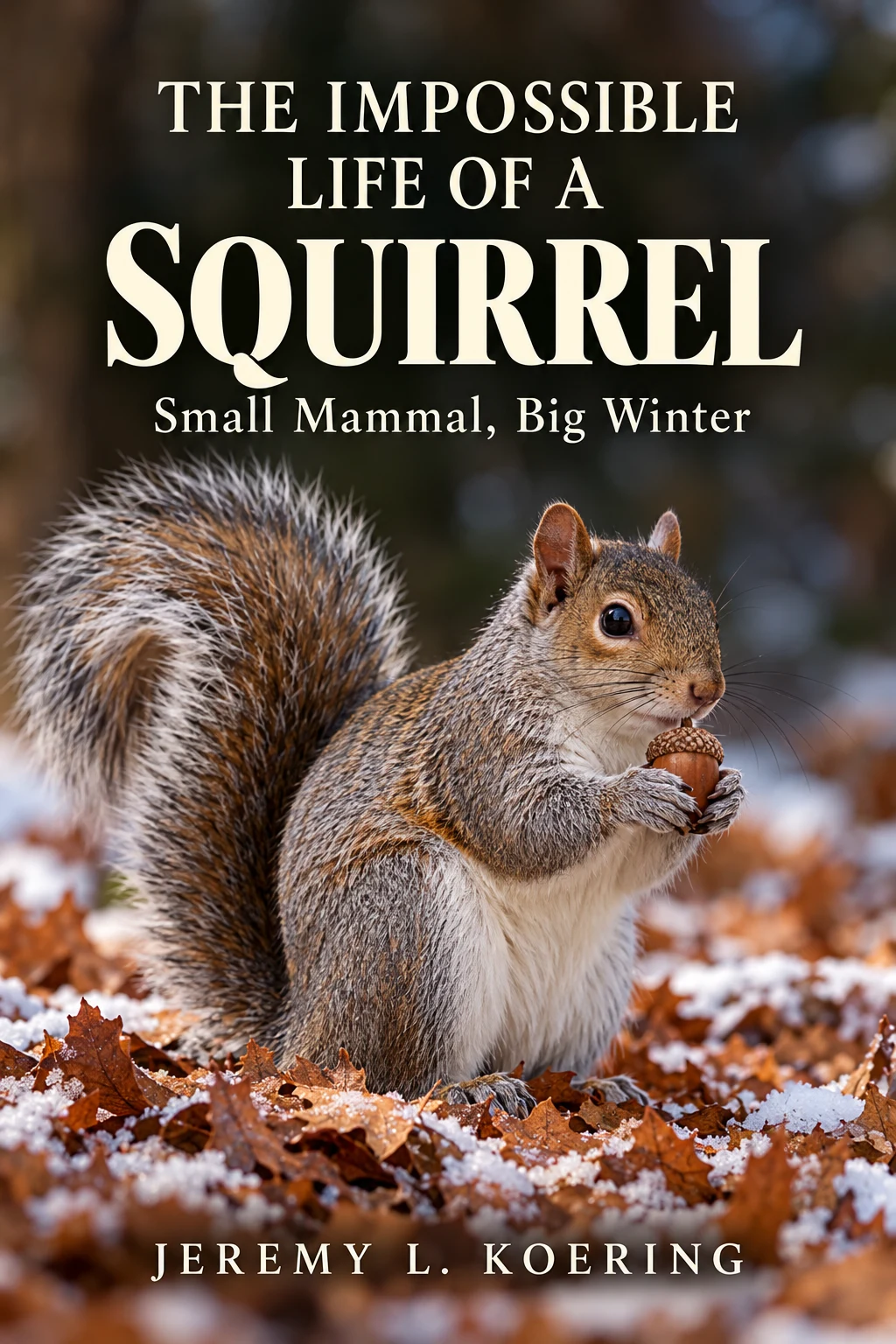
The Impossible Life of a Squirrel
Small Mammal, Big Winter
An eastern gray squirrel carrying an acorn can seem like an ordinary autumn sight. This book follows the animal through gathering, winter survival, and the next generation, taking a closer look at its relationship with the surrounding woodland.
These resources accompany the book’s focus on the Northeast and Mid-Atlantic. Explore the species accounts, look into the research, or take a question with you on your next walk.
The Amazon links on this page are affiliate links. As an Amazon Associate I earn from qualifying purchases.
Available in Kindle and paperback.
Choose your edition on AmazonExplore the companion resources
Look a little closer
Watch quietly from a distance. Notice where a squirrel pauses, which trees are nearby, and what the ground looks like around it. Describe what you can see before deciding what the animal is doing.
A notebook prompt: Write down one visible action, one feature of the surroundings, and one question you cannot answer from the observation alone.
Leave nests and dependent young undisturbed. A brief observation can be enough.
Species accounts and supporting research
Meet the eastern gray squirrel
Animal Diversity Web’s species account provides identification, distribution, and life-history context.
Read the species accountSquirrels in our neighborhoods
MassWildlife introduces regional squirrels and practical coexistence considerations.
Explore MassWildlife’s guideFood stores and the forest
Steele and Yi’s 2020 research review examines squirrel scatter hoarding and its ecological consequences. It covers multiple species; findings should be read in that context.
Read the open-access reviewOak seeds and establishment
The U.S. Forest Service’s northern red oak account offers woodland context for seed production, regeneration, and the conditions affecting young trees.
Read the northern red oak accountFurther reading cited in the book
The recommendations below are limited to books whose relevant material was consulted and cited in this manuscript.
As an Amazon Associate I earn from qualifying purchases. The Amazon link below is an affiliate link; a qualifying purchase may earn a commission at no additional cost to you. Free reading and publisher links are also provided.
The Mammals of Texas
David J. Schmidly and Robert D. Bradley · Seventh edition, 2016
A reference to Texas mammals, with species descriptions, life histories, and distribution information. The book’s eastern gray squirrel account was consulted through Texas Tech University’s online edition and cited in Chapter 6.
This is a regional reference for Texas, rather than a guide to the Northeast and Mid-Atlantic. Its species account is useful for comparing regional natural history.
Read the consulted squirrel account free · Visit the publisher
Find the book on AmazonBiology 2e
OpenStax · Free online textbook
A broad introductory biology textbook. Section 33.3, “Homeostasis,” was consulted and cited for Chapter 4’s explanation of temperature regulation.
This is general biological background, rather than squirrel-specific research. Read it alongside the species-specific sources in the chapter notes.
Read the cited section free